Creative ideas CURiOUS MINDS

Bridging the Gap Between Narrative, Material, and Memory

designing 'low-floor, high-ceiling' exhibits that empower users to move from passive observation to sensory-led discovery.

By leveraging material intelligence, I transform complex narratives into tactile experiences people can hold, influence, and remember.

Rather than designing static displays, I create spaces where the visitor is not a spectator, but an active participant.

By using tactile metaphors—the squish of a pillow, the cold weight of an underwater totem, the crank of a siren—I pull people out of their heads and into the story. It’s a way to break through the “museum-glaze” and trigger real, visceral memories. This allows me to take on heavy topics like the Blitz or homelessness, using empathy and ‘Deep Play’ to make the untouchable feel personal.

SELECTED PROJECTS

Play + Pedagogy

Designing for Discovery: Utilising the power of play to harness the audience’s engagement, promoting active learning.  Through ‘low floor, high ceiling’ interactions, play becomes a pedagogical tool,  enabling them to become empathetic participants and have agency within their own learning.

Shipwrecks of Plymouth

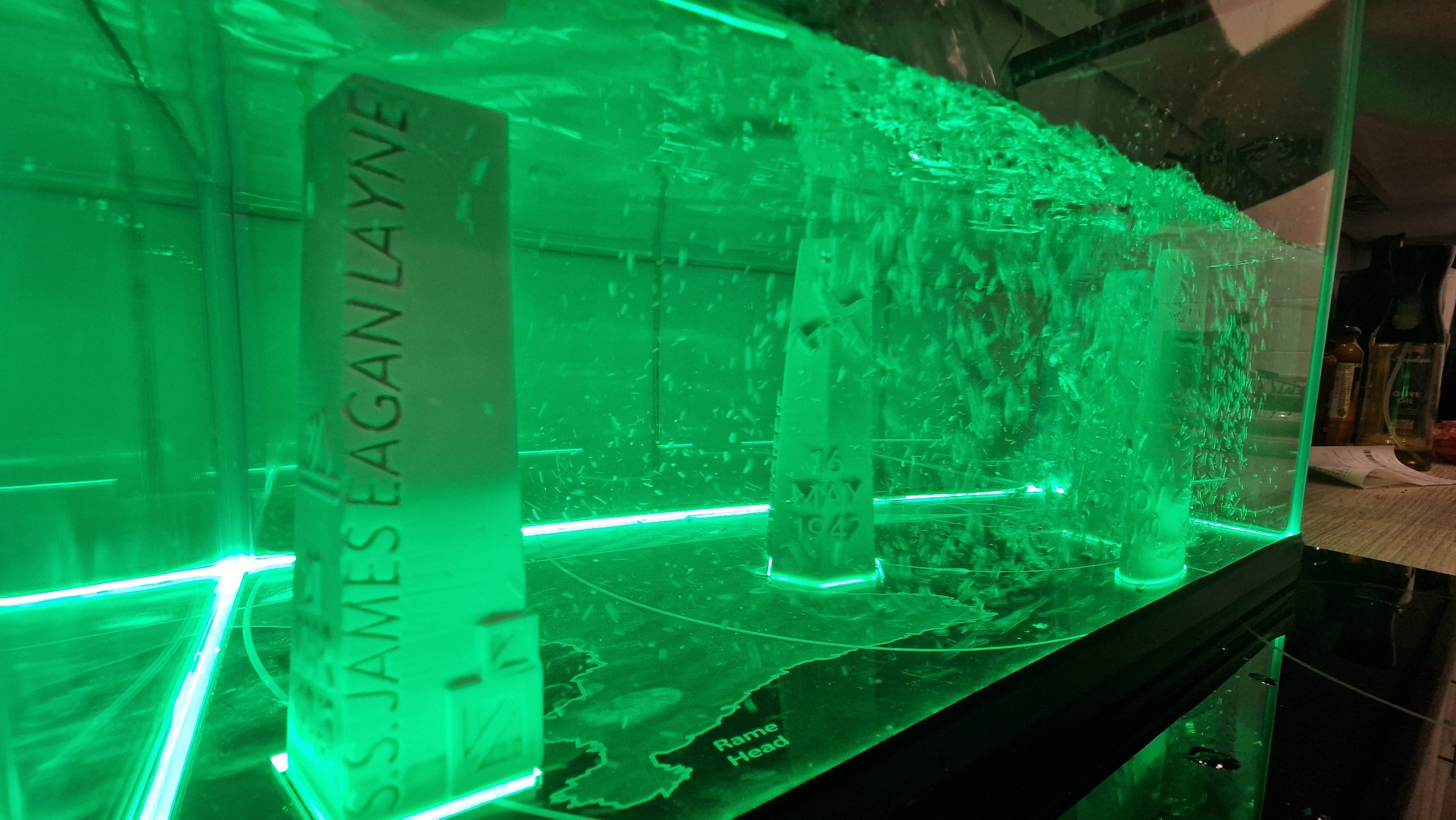
How do you make a flat, digital archive meaningful to a child? I deconstructed untouchable maritime data into a suite of tactile, “phygital” totems. By creating a physical-to-digital interaction model, I gave users agency over their own discovery and context to the informaiton given, proving that sensory rituals significantly increase information retention and digital engagement.

Shelter:
Where i lay my head is my home

I wanted to move beyond the data-driven campaign of traditional social advocacy to a more empathy-heavy understanding. By asking: Where would you lay your head?  I utilised the ‘Material Metaphor’—soft, squishy pillows that participants are invited to physically place in their location of impossible choice scenarios. This high-engagement intervention successfully stimulated much conversation over privacy, safety and agency – issues faced by people who are homeless, and was part of enhancing direct dialogue with local council planners.

IMMERSIVE NARRATIVE SPACES

Spatial Storytelling: Designing environments that guide the viewer to question events and engage with the topic on an emotive level. By enacting the senses and the way that we emotively connect with an event, I create spaces that encourage you to feel the experience as much as view it.

plymouth bomb book

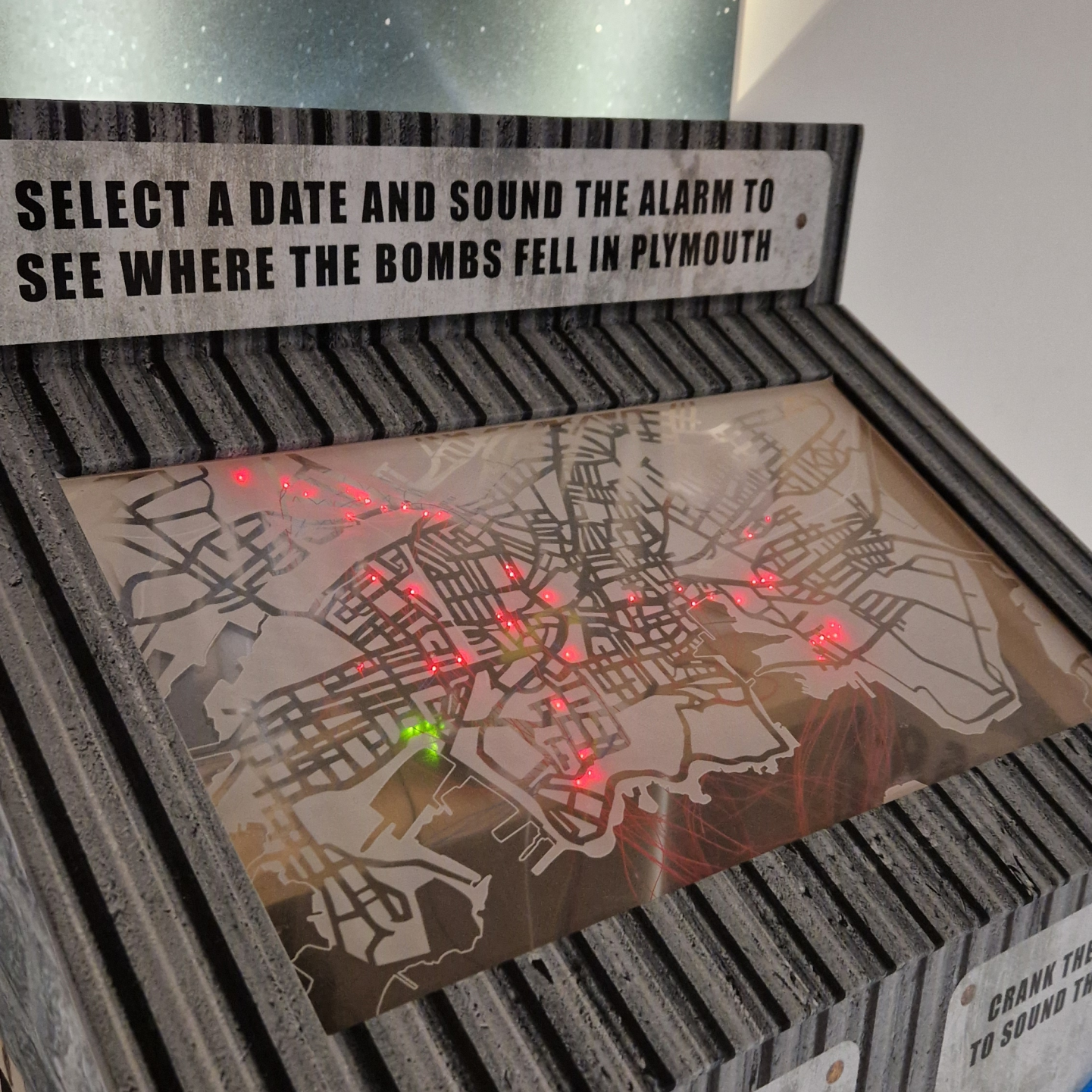
I explored how different modes of interaction move audiences beyond digital archives. I designed a mechanical experience, that acts as the anchor for a choreographed sensory environment. By physically raising an air-raid siren to begin the narrative, the participant triggers a synchronized landscape of sweeping searchlights and falling “bombs” of light. This multi-sensory immersion removes the disconnect of traditional data-viewing, creating a meaningful, lived experience that restores the emotional weight of the Plymouth Blitz.

Disconnect: Freya’s Story

In a world where we are constantly connected yet increasingly lonely, what is the cost of our physical absence? I used the sensory narrative of “Freya” to question the toll of being “there but not present,” where digital distractions lead to a profound disconnection from our immediate environment. Drawing on the theories of Grace Boyle, I engineered a multi-modal “threshold” that uses scent, sound, and childhood nostalgia to break the digital spell. By inviting participants to reclaim their agency through a tactile Polaroid ritual, the project serves as a provocative reminder to remain present in the physical world.

community strategy

Designing for Discovery: Utilising the power of play to harness the audience’s engagement, promoting active learning.  Through ‘low floor, high ceiling’ interactions, play becomes a pedagogical tool,  enabling them to become empathetic participants and have agency within their own learning.

Explorer’s Quest

Working as the Strategic Lead within a creative group, I developed a framework to revitalise a local children’s heritage trail. Based on extensive parent surveys and user-led research, we moved away from “checklist” tourism toward a model that prioritises deep engagement within the space. I engineered a three-tiered pricing structure to support our partner CIC, ensuring the project remained financially sustainable while meeting local needs. By shortening the trail and integrating narrative-led street furniture, we tapped into children’s imaginations to turn historical archives into a lived, community experience.

Lumina Legacy

In response to UN SDG 12, I explored how we can transition from “Responsible Production” to “Emotional Longevity.” Inspired by the loss of narrative attachment in inherited objects, I designed a lighting system centered on the ritual of use. By removing the light and adding your hand print, you are feeding into the item’s history through tacit interaction. It becomes a catalyst for shared stories and collective memory. Applying Jonathan Chapman’s theories, this project proves that objects stay relevant across generations not through their utility, but through the evolving stories they carry.

Material research

Material exploration: utilising material and process experience across engineering and crafts. From 3D photogrammetry scanning and CAD manipulation to advanced glass and ceramics craftmanship, this is the technical foundation to bringing concepts off the page. 

Abbott x Savage
National Trust – Lanhydrock House

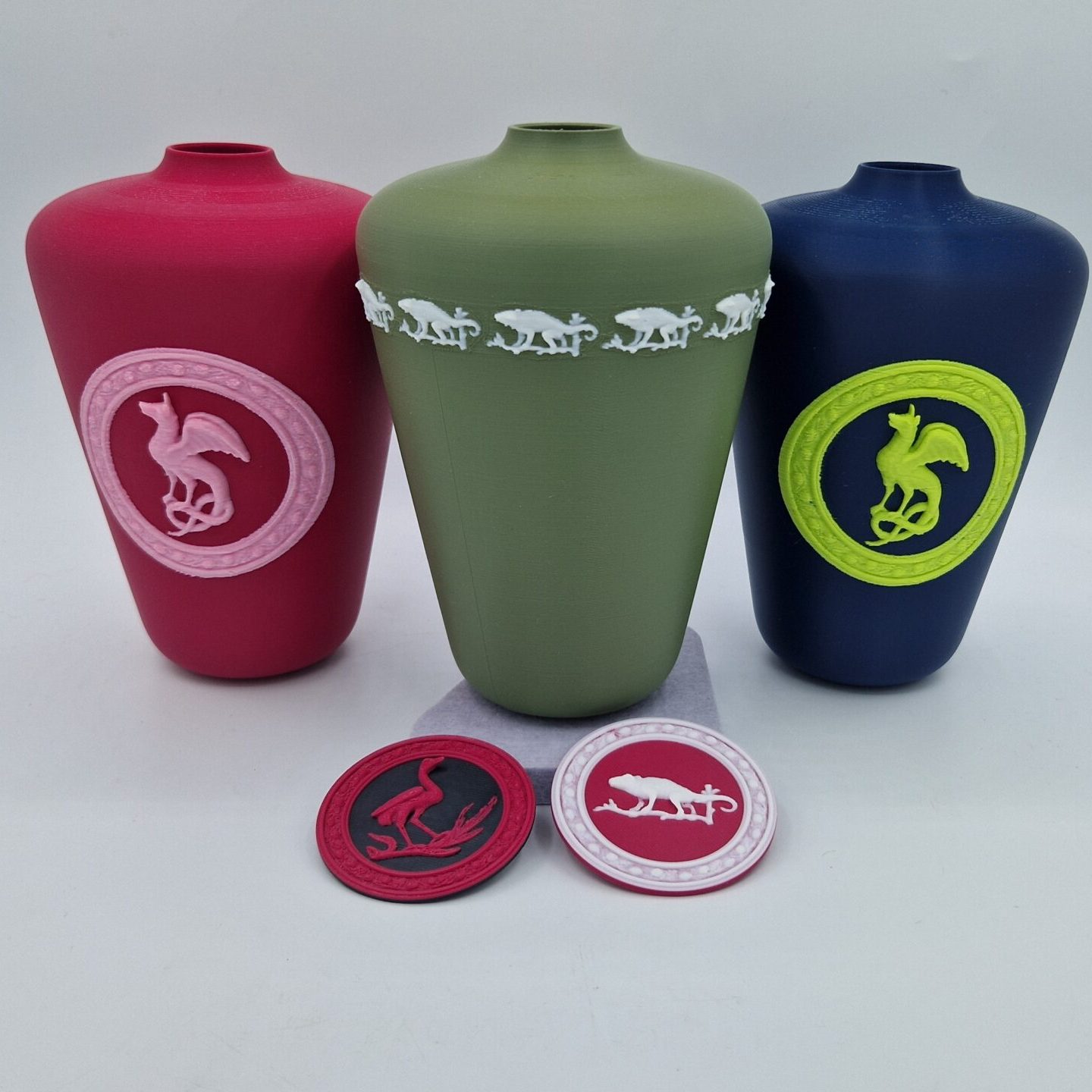
I used high-fidelity restoration scans to open a 400-year craft dialogue with the Abbott family of master-molders. Acting as Product Strategist and 3D Specialist, I deconstructed sub-millimeter mesh data to bring “untouchable” Jacobean plasterwork off the ceiling and into people’s hands. By optimizing workflows across resin, CNC-machined hardwoods, and vacuum-formed molds for the museum café’s chocolate, I developed a model for Democratic Heritage Access—converting unreachable history into tangible, high-fidelity pieces for the modern home.

technical foundation

draw_abstract

Materials &
Prototyping

Phygital Prototyping:
Arduino (interactive hardware), 3D Scanning, and 3D Printing.

Material Science:
Advanced casting (Metal/Glass/Ceramic), Woodworking, and Textiles.

High-Fidelity Prop Making:
Specialised skills in scale, modularity, and tactile finishing.

family_history

Digital Visualation
& Production

3D Modeling:
High-fidelity visualization in Blender, Rhino, and AutoCAD.

Strategic Design:
Document and pitch deck creation using InDesign, Illustrator, and Photoshop.

Technical Drafting:
Creating blueprints that bridge the gap between “sketch” and “manufacture.”

graph_3

Leadership
& Strategy

Creative Direction:
Leading multi-disciplinary teams from abstract concepts to high-fidelity outcomes.

Strategic Play Discovery:
Utilising research (Ethnography/Ethograms) to define audience engagement.

Technical Mentorship:
Bridging the gap between engineering, design, and education (FHEA/EngTech).

Communication:
Translating complex technical systems into simple, compelling stories for stakeholders.

I have always believed that if something is worth doing, it is worth doing well.

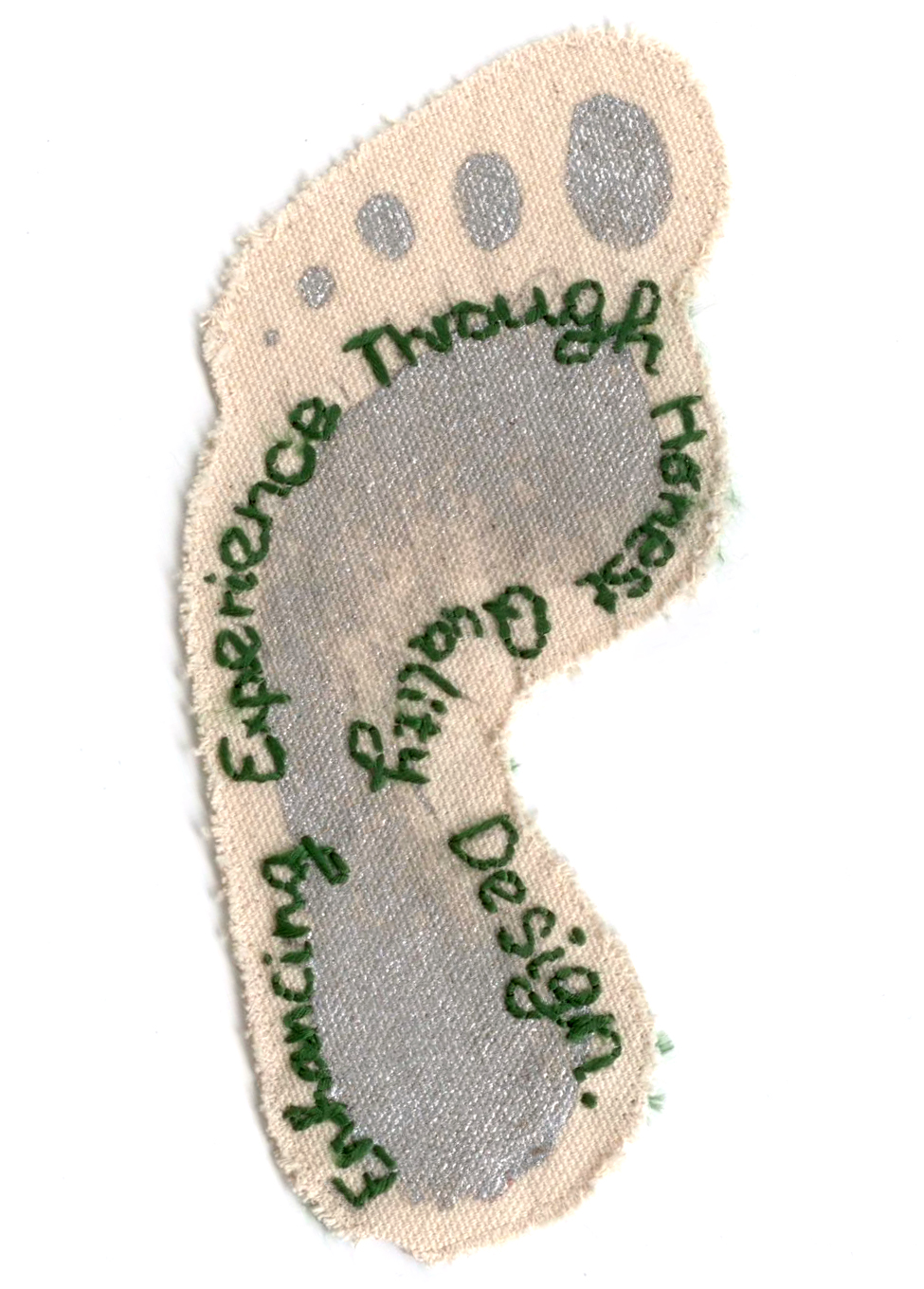
I hand-stitched this footprint as a reflective manifesto—a slow, deliberate process to align my hands with my head. For me, the act of making is a commitment to Quality, Honesty, and Experience. It serves as a reminder that whether I am deconstructing a digital mesh or shaping physical timber, the work requires a level of intentionality that can’t be rushed. It is my signature on every project: a standard that is felt as much as it is seen.